
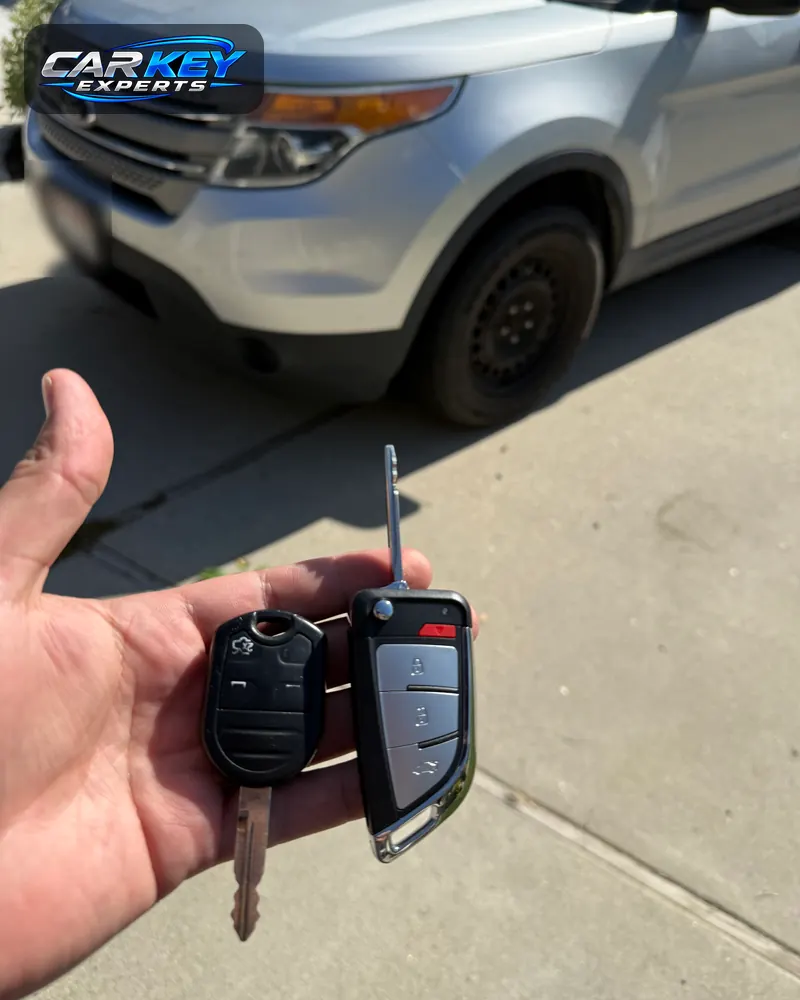
What kind of car key do I have? Check its three parts
If your question is “what kind of car key do I have?”, treat the key as a set of parts, each with one job. The blade is the cut metal that turns the door lock and, on many cars, the ignition. The chip, also called a transponder, is a tiny radio part sealed in the head that tells the car this key belongs to it. The remote is the row of buttons that locks and unlocks the doors from a distance.
Some keys carry one of these parts and some carry all three, while a smart key trades the turning blade for a radio signal.
The common key types, side by side
- Plain metal key. An all-metal head with no plastic and no buttons: a blade and nothing else. Some older GM cars and pickups add a small resistor pellet in the blade (GM called it VATS), and a new key has to match that pellet.
- Chip key. A blade under a plain plastic head with no buttons. The plastic hides the transponder, which the immobilizer has to recognize. The immobilizer is the electronic guard in the car that lets the engine run only when it reads a chip it knows.
- Remote-head key. Blade, chip and lock buttons molded into one solid head, so all three parts have to be made or paired.
- Flip key. The same three parts, but the blade folds into the head and springs out when you press a release.
- Fobik. A fob with a short blade on one end that slides into a slot in the dash and turns there. Many Dodge, Ram and Jeep models from about 2008 on use one.
- Smart key. A fob with no visible blade, made for cars that start with a button. It talks to the car by radio from a pocket or purse, which is why it is also called a proximity key. Most hide a small emergency blade for the driver's door.
- Laser-cut blade. A blade style rather than a key type: a wavy groove runs down the flat face instead of teeth along the edge, and some people call it a sidewinder. It shows up on chip keys, flip keys and inside smart keys.
Small clues that settle the question
- A letter on a Toyota blade. On many 2010s Toyota keys, a letter stamped near the head, such as G or H, tells which chip is inside. Read it to us on the call.
- A blinking security light. A small key or padlock light may blink on the dash after the engine is off. On many cars that light belongs to the immobilizer, which means the key carries a chip.
- How the engine starts. If you press a button on the dash and the fob never goes into a slot, you have a smart key, even when it looks like a plain remote.
- The year and make. Most Fords from about the late 1990s on carry a chip in the head (Ford calls the system PATS), and most Toyotas and Hondas from about then on use chip keys too. The owner's manual usually names the key type as well.
Checks you can make without opening the key
Looking and testing are safe: press each button near the car, try the blade in the driver's door, and check the head for a crack that could let the chip slip out.
Leave a sealed key closed. Many are not built to come apart, and prying one open can break the plastic around the chip or the circuit board.
The chip also explains a common surprise: a copy cut at a key counter can open the door yet leave the engine silent, because the blade fits but the immobilizer never hears from a chip it knows.
Why your key type changes the job
The type tells us what has to be made. A plain metal key needs cutting only, and a chip key needs cutting plus programming. A remote-head key, flip key or fobik needs all three parts set up, and a smart key is enrolled by radio with its emergency blade cut to match.
Whether any key still works matters as much. Copying a working key is covered under spare keys and copies, while a car with no key left is handled under replacing lost car keys. If you now know you hold a chip key, the transponder key page explains how the chip is programmed; for button-start cars, see smart keys for push-to-start cars.
We work on car keys only, on most makes and models, whether the car is a Subaru, Ram, Hyundai, BMW, Ford, Toyota, Honda or Chevrolet. We come to where the car is parked in Nampa or anywhere in Canyon and Ada counties, from Caldwell to Meridian. Call (208) 480-6980 day or night; once we know the key type, you get the price on that first call.